(warning, strong language)
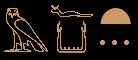
The doctrine of God is of utmost importance to one's personal theology. Now, what, may one ask, is the doctrine of God of those who run the whole charade? Lets start in Egypt (our favorite destination):
A hymn from Esna states that Neith fashions the world “in her form of
Goddess who reaches to the limits of the universe, in her material form
of the liquid surface, in her name of unlimited duration,” (Esna, vol. 5, p. 111); “the extension of the water which makes eternity [heh],” “the stream which fashions everlastingness [djet],”
(ibid., p. 114 n. i). Neith’s independence and autonomy are emphasized
in her demiurgic activity. Thus it is often said that Neith is both
feminine and masculine – “two thirds masculine, one third feminine,” (Esna,
vol. 5, p. 110) – both mother and father, “who inaugurated birth when
birth had not yet been,” (Lichtheim, vol. 3, p. 38), having “appeared
from herself,” (Esna, vol. 5, p. 253). The primordial register
in which Neith’s cosmogonic activity occurs can be seen from the fact
that, in the version from Esna, Neith brings forth both Re, the
principle of cosmic order, and Apophis, the principle of entropy.
Neith was the male-female creator and represented the flow of time, matter. She was called the Queen of Heaven in the same fashion as Isis, and represented wisdom. Now, in this she was the archetype or the direct inspiration behind an interesting type of the gnostic Sophia. The Sethians were a particularly anti-Jehovah sect, and worshipped a compound deity called Barbelo, which, juxtaposed next to Neith, seems a direct "port" into the latter mystical religion. And it was not only the Sethians
THE
DIVINE BARBELO
Another syncretic goddess of the Egyptian Gnostics
is Barbelo. She resembles Khokhmah in her presentation as a divine emanation.
The Sethian scripture Allogenes calls her “the first Arche of blessedness, the Aeon of
Barbelo, full of divinity, and the first Arche of that one without Arche, the
spiritual invisible Triple Power, the All that is higher than perfect.”
[Arthur, 165] Many writers refer to Mother Barbelo as part of a trinity, along with the Father and Son. Here the Christian influence comes into view, but it
is tempered by Egyptian themes: the trinity abides in the female sphere of the
“Eighth.” [Pagels, 166; Arthur, 166] Epiphanius reports that the Gnostics
placed Barbelo with Christ in the Eighth heaven. [Doresse, 43]
Attempts
to reconcile conflicting traditions results in contradictions in the Barbelo
literature. The Gospel of the Egyptians says that Barbelo originated from herself, as the
ancients had said of Neit, Mother of the Gods. But the Three Stelas of Seth represent her as “the first
shadow of the holy Father,” who existed before her. Its author addresses her
with feminine pronouns, but paradoxically praises her as “the male virginal
Barbelo.”[Arthur, 165-6] A later passage reverts to goddess imagery:
Thou
art a Sophia. Thou art a Gnosis. Thou art truth. Because of thee, there is
life. Life is from thee. Because of thee, there is mind... Thou art a cosmos of
truth.
Thou
art a triple power... [Arthur, 166]
The
Sethians said that this trinity was made up of Light, Breath, and Darkness. The
Peratae had it as Father, Son and Matter, with the Son mediating between the
exalted Father and a passive female principle. [Both according to the Philosophumena, in Doresse, 52, 50]
But
the Trimorphic Protennoia exalts “Barbelo, the perfect glory, and the immeasurable
Invisible One who is hidden."
She is called Protennoia—Primal Thought—who "dwells in
the Light," and from her originated a trinity of Father, Mother, Son. This
scroll begins with an aretalogy that praises her as "the movement that
dwells in the All...she who exists before the All." [Trimorphic Protennoia, tr by John D.
Turner, <www.gnosis.org/naghamm/trimorph.html>]
I move in every creature... I
am the Invisible One within the All... It is I who poured forth the water. It
is I who am hidden by radiant waters. It is I who gradually put forth the All
by my Thought. It is I who am laden with the Voice. It is through me that
Gnosis comes forth.” [Ibid]
Protennoia's
connection with the waters recalls the primal flood of Neith and Isis, who
brought forth the Nile inundation. And like both goddesses who were mothers of
the sun, Neit to Ra and Isis to Horus, Protennoia proclaims, "I am the
Womb that gives shape to the All by giving birth to the Light that shines in
splendor. I am the Aeon to come. I am the fulfilment of the All, that is,
Meirothea, the glory of the Mother." [Ibid check is this Arthur?]
The
Apochryphon of John contains another aretalogy of “the perfect Pronoia of the universe,”
who was the First. She represents “the light which exists in light,” but
wandered in the great darkness, “into the midst of the prison,” and the depths
of the underworld. [not Arthur?, 132, 162-7] However, this book unfavorably
compared “sister Sophia” to Barbelo. A splitting of Gnostic goddess images was
underway, in the process of subordinating her to “the Father.” The Christian
authors now disparaged the independence of a goddess not firmly partnered to a
male god. These derivative Gnostic
aretalogies reflect an emerging concept of the “fallen” goddess.
The
longest aretalogy appears in Thunder, Perfect Mind, which follows the form of the
old Isis litanies:
I
am the first and the last.
I
am the honored one and the scorned one.
I
am the whore and the holy one.
I
am the wife and the virgin
I
am the mother and the daughter
I
am the members of my mother
I
am the barren one, and many are her sons....
I
am the silence that is incomprehensible
And
the idea whose remembrance is frequent
And
the word whose appearance is multiple
I
am the utterance of my name.
[Kurt
Rudolph, Gnosis: The Nature and History of an Ancient Religion, 1984, in Long]
Further
on there is a veiled but pointed reference to Isis: “I am the Sophia of the
Greeks/ And the Gnosis of the barbarians/ I am one whose image is great in
Egypt...” Unlike the pagan aretalogies, however, Thunder is dualistic, pairing
negatives—”ignorance... shame... fear”—with Barbelo's divine
qualities. [Arthur, 7, 164, 173-5. She reasons that Thunder was originally titled The
Divine Barbelo,
based on abbreviations and the association of Barbelo with the title
"Perfect Mind."] Some of the lines in Thunder resemble verses in the “Song of
the Woman” in the Origin of the World. This version attributes the song to Eve, assigning her
a male lord not present in Thunder. In the Hypostasis of the Archons, similar declarations about Eve
are put in Adam’s mouth. [Arthur, 162, 148]
"This is the first thought, his image; she became the womb of everything,
for it is she who is prior to them all, the Mother-Father, the first
man (Anthropos),
the holy Spirit, the thrice-male, the thrice-powerful, the thrice-named
androgynous one, and the eternal aeon among the invisible ones, and the
first to come forth."
Anyone who has read the 8th chapter of the proverbs knows that Jesus is described as the Wisdom of God, the one set and anointed before all, the first emanation of God into the emptiness to create the worlds etc. The gnostic Sophia/Barbelo is an attempt to replace Christ in his creative, redemptive, eschatological roles etc with a all encompassing hermaphrodite (mother-father of good and evil).
Barbelo was to be found in the 8th heaven alongside Jesus and was a hermaphroditic virginal being that created itself and directs the flow of time and matter in the age to come. What is interesting is that one of the groups that God despises and condemns in the Book of Revelation (which was left outside of the RCC and EO reading list) , the Nicolaitans, apparently also worshipped Barbelo.
She is noticed in several neighbouring passages of Epiphanius, who in part must be following the Compendium of Hippolytus, as is shown by comparison with Philaster
(c. 33), but also speaks from personal knowledge of the Ophitic sects
specially called "Gnostici" (i. 100 f.). The first passage is in the
article on the Nicolaitans
(i. 77 f.), but is apparently an anticipatory reference to their
alleged descendants the "Gnostici" (77 A; Philast.).
Barbelo
https://en.wikipedia.org/wiki/Barbelo
In our discussion of the major demolition project of the jesuits to pull down the stern, separate, masculine image (and doctrines....and Bibles) of God, it was mentioned how the main blow to the traditional Biblical idea of God will come with
"Mary absorbing Jesus and His wrath completely and His Redemption and judicatory destruction becoming utterly meaningless."
.............."if she (Sophia/Eve) enters into him and he takes her
to himself, death will no longer exist" .......
One earth, one faith - part 2 - Fossil fuels and fossil masculine Jesus
https://jesus-partisans-on-the-balkans.blogspot.com/2022/05/one-earth-one-faith-part-2-fossil-fuels.html#comment-form
So one way for her to "enter" is to make her a part of the trinity. Well, that already has been done in Pentecostalism and liberal theology where the Holy Spirit has been described as feminine. Which makes God one third woman. It is curious that there is a strand of theology in Roman Catholicism that admits Mary as part of the godhead. But even within broader RCC thought one can't escape the thought that Mary is elevated to godhood and made a representative of the Holy Spirit. A poll taken at a parish in Ireland showed that the majority of catholics think Mary should be considered a part of the trinity. The only divine work she has not been fully admitted yet is redemption. For now, she is 'only' the house of the trinity, a dispenser or vessel of grace. But with the fifth dogma, she will be elevated as co-redemptrix etc... a title only applicable to Jesus, the God and Savior.
All this profanity and travesty of a hermaphrodite self-generating androgynous god was condemned in the Book of Revelation. Curiously, this book condemns both the gnostic Nicolaitans that are said to be attempting to infiltrate certain churches and a great Whore church that is the result of that infiltration. And curiously, the Whore suffers plagues very reminiscent of the ones against Egypt with their river and water goddess Neith - the one the Nicolaitans went on to call Barbelo (Spiritually the new city is called Egypt). Even more shockingly, the phrase "one third" and rivers and waters (symbol of Neith) seem to feature prominently in the description of the plagues:
Revelation 8:7 The first angel sounded, and there followed hail and fire mingled with blood, and they were cast upon the earth: and the third part of trees was burnt up, and all green grass was burnt up.
Revelation 8:8 And the second angel sounded, and as it were a great mountain burning with fire was cast into the sea: and the third part of the sea became blood;
Revelation 8:9 And the third part of the creatures which were in the sea, and had life, died; and the third part of the ships were destroyed.
In the Book of Exodus the first plague is directed against Neith - one of the deities of the river Nile.
The 1st plague was directed against the Nile itself, which the Egyptians worshipped as their source of life. This plague confronted the numerous river deities, including Khnum (guardian of the Nile), Hapi (spirit of the Nile and god of fertility) and Osiris (god of the underworld, whose blood the Nile was considered to be). By turning the Nile into blood and killing the fish (supposedly protected by Hathor and Neith), Moses was not only shaming all these Egyptian objects of worship, but also showing that sustenance comes only from the hand of Yahweh.
The ten plagues of Egypt
https://creation.com/the-ten-plagues-of-egypt
Now, I will not attempt to treat the nature and fulfillment of the plagues here - the link is what is important. Later on, the devil is said to drew the third part of the stars of heaven, and did cast them to the earth. The Nicolaitans are said to come from Nicholas, one of the first seven deacons of the church. Seven can't be divided by three, but if we recollect that Stephen was martyred, we are left with 6 men. This must mean that Nicholas was not alone in his apostasy - one of the remaining six could have been "dragged down" by Satan as well. Since the Nicolaitans were called so after Nicholas and there is a gnostic work that goes by the gospel of Philip, it is easy to assume that the apostle Philip or some disciple of his was the other protoapostate. However, this is completely in the mists of speculation and since the Bible testifies of Philip as being tested and led by the Holy Spirit, it is rather unlikely. This much we know about the link.
One can't help but wonder if the next entity in the male-male-female trinity line is some masculinized Mary or an effeminated Christ, or both. Seeing that the spiritual Egyptians are preparing for a grand return on the world stage, the gender equalizing must be more than visible, it must be the highlight contour of this grand re-entrance of the real "god". To wedge in the Trinity might just be more damning than to replace it altogether. After all, God does not like to share his glory with another. Which was what Satan has been trying to do ever since Noah's sons populated the world.


.jpg)